
Warren County Court Records After Arrest
After a Warren County jail arrest, the custody record and the court record move on different tracks. The jail roster says whether a person is currently held at Warren County Jail. The court record shows the formal case once the proper court receives a complaint, information, indictment, citation, bond order, warrant entry, hearing notice, or disposition. Felony matters often begin in a lower court and then move to Warren County Common Pleas after bindover or indictment.
The booking side and the court side should be checked together, but they are not the same record. For current custody and booking status, use Warren County jail inmate records. For booking-photo questions, use the Warren County jail mugshots page. The court record after a jail arrest is the case file and docket trail, not a mugshot gallery or jail-only roster entry.
Find Court Records After Arrest
Warren County has several possible criminal court paths. Common Pleas handles felony and other higher-level matters. Warren County Court handles criminal, traffic, and civil matters for Clearcreek, Hamilton, Harlan, Massie, Salem, Union, Washington, and Wayne townships. Lebanon Municipal Court, Mason Municipal Court, and Franklin Municipal Court may handle matters tied to their local jurisdiction. The arresting agency and place of offense often point to the right first search.
- Search the jail roster first when current custody or booking status is uncertain.
- Identify the arresting agency, place of offense, and charge level if known.
- Search Common Pleas, Warren County Court, Lebanon Municipal Court, Mason Municipal Court, or Franklin Municipal Court based on jurisdiction.
- Use defendant name first, then case number if known.
- Compare roster language to the formal court charge, because the prosecutor or court may amend the charge.
- Call the court clerk when a recent arrest has not posted or when a verified copy is needed.
The official Common Pleas case inquiry page states that users may search by name or case number, choose a case type, and view histories for cases filed since May 1991. It also says the public inquiry does not currently provide the actual filing documents associated with a case.
Warren County Common Pleas Records
Common Pleas criminal records are important after felony arrests. The Clerk of Courts Common Pleas Division is at 500 Justice Drive, P.O. Box 238, Lebanon, Ohio 45036, and the office phone is 513-695-1120. The clerk's case-inquiry page says the system covers Civil, Criminal, and Domestic Relations cases, with updates several times during a normal business day and once again overnight. Older cases from 1980 to May 1991 may have only case/reference numbers and captions online.
The court database screenshot from the manifest comes from the public-access court database linked by the Clerk. The Common Pleas public access database is the source for that court-record search screen.
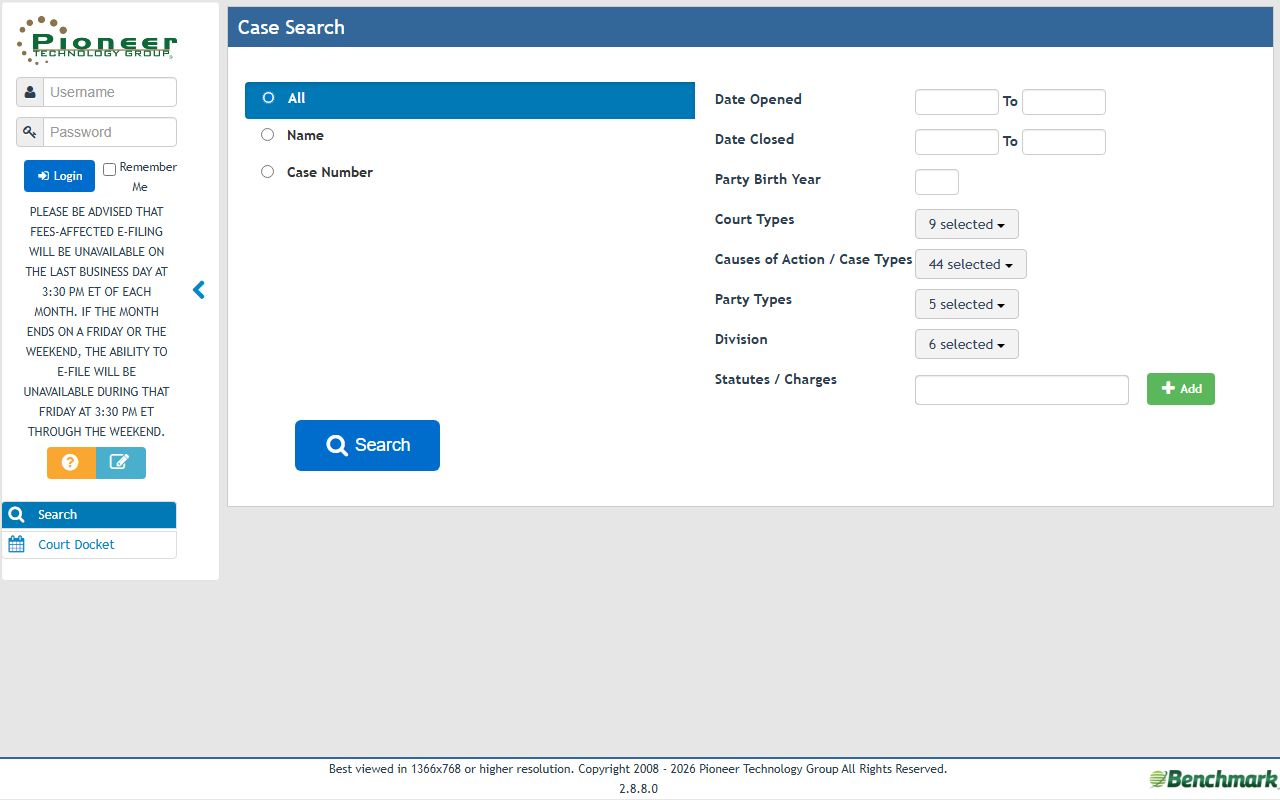
The public search helps locate the docket, but verified document copies or older off-site files may require direct contact with the Clerk's office.
| Field label | Type | Required | Notes |
|---|---|---|---|
| Name | Text | Optional search path | Official page says users may enter a name. |
| Case number | Text | Optional search path | Useful once a court number is known. |
| Case type | Selector | Needed to narrow | Civil, Criminal, and Domestic Relations are noted by the clerk page. |
| Search | Button | N/A | Begins the database lookup. |
County and Municipal Court Records
Warren County Court is at 880 Memorial Drive in Lebanon, with phone 513-695-1370 and hours Monday through Friday, 8:00 AM to 4:00 PM except holidays. Its official page says it handles about 8,000 criminal, traffic, and civil cases each year and tells users to call if needed information cannot be located online. Its navigation includes Record Search, Posting Bond, Bond Schedule, misdemeanor criminal complaint after arrest, affidavit for warrantless arrest, and after-hours warrant request materials.
Lebanon Municipal Court uses CaseLook and warns that electronic data can lag at least 24 hours or longer between filing, judicial action, and online posting. That warning is important when someone was arrested recently. If a record must be verified, Lebanon Municipal Court directs users to request information from the court or visit during business hours. Mason and Franklin municipal court links also appear in Warren County court navigation, so local arrests may need a city-specific search.
Charges After Warren County Arrest
The charging document is the bridge between an arrest and a court record. Police may submit a complaint, affidavit, report, or warrant packet. The prosecutor then reviews the evidence and decides what charge should be filed, amended, reduced, dismissed, or presented to a grand jury. Ohio counties use a Prosecuting Attorney title rather than District Attorney. In Warren County, Prosecuting Attorney David P. Fornshell's office handles prosecution functions, especially felony matters.
| Document | Common use | What it starts |
|---|---|---|
| Complaint | Often used in misdemeanor, traffic, or early criminal proceedings | States the accusation that opens or supports the case. |
| Information | Used by prosecutors in some felony paths | Charges a case without a grand-jury indictment when allowed. |
| Indictment | Felony cases presented through a grand jury | Moves formal felony charges into Common Pleas. |
Warren County Court's officer forms include misdemeanor criminal complaint after arrest and warrantless-arrest affidavit forms. Those forms support the record path from arrest to filed charge.
Warren County Charge Status
Charge status can change quickly after arrest. A booking charge may describe the arrest basis, while the prosecutor's filing describes the formal charge in court. The court may later reduce, amend, dismiss, merge, or dispose of a count. A pending charge is not a conviction. A dismissal, no bill, or not-guilty finding may later support a sealing request under Ohio law if the person is eligible.
| Status | Meaning in a court record |
|---|---|
| Pending | The charge is open and has not reached final disposition. |
| Amended or reduced | The filed charge changed, often by prosecutor action, plea, or court order. |
| Dismissed | The charge was ended without conviction on that count. |
| No bill | A grand jury did not return an indictment on the presented charge. |
| Conviction | A guilty plea, no-contest finding, or verdict produced a final criminal finding. |
Bond After Warren County Arrest
Bond controls release, but the issuing court controls formal bond conditions. Warren County Court navigation includes Posting Bond and a Bond Schedule PDF, and Lebanon Municipal Court also links bond-related resources. Ohio law allows several release forms, including cash bond, surety bond, recognizance, and no-bond holds. The court may consider the nature of the offense, weight of evidence, community ties, criminal record, and public-safety concerns under ORC 2937.22.
| Bond type | How it works |
|---|---|
| Cash bond | A cash amount must be posted with the correct court or jail channel. |
| Surety bond | A bail agent or surety posts bond for a fee; no specific company should be recommended. |
| Personal recognizance | Release is based on a promise to appear and comply with court conditions. |
| No-bond hold | Release is unavailable until a judge or another agency acts. |
| Warrant bond | A bond amount may be tied to an active warrant or issuing court order. |
Warrants and Court Records
A warrant can lead to booking at Warren County Jail, but the issuing court may control bond, recall, transfer, or the next court date. Lebanon Municipal Court has an active-warrants portal. Common Pleas matters may appear in the Clerk's database after filing, and Warren County Court can be contacted when a township case is not clear online. The sheriff records process can help route sheriff-held warrant records, but no official statewide Ohio public warrant portal covering all Warren County warrants was located in the research pass.
Charges vs Convictions
Being arrested and charged does not mean the person was convicted. A charge is an accusation in a court record. A conviction follows a plea, verdict, or finding. This distinction matters for public records, employment-related questions, sealing eligibility, and how a court docket should be read.
| Charge | Conviction | |
|---|---|---|
| Stage | Accusation or filed count | Final finding after plea, verdict, or judgment |
| Proof level | Probable cause or filing basis | Beyond a reasonable doubt in criminal cases |
| Can change? | Yes, charges can be amended, reduced, or dismissed | Changes usually require appeal, post-conviction action, sealing, or expungement |
Sealed and Expunged Records
Ohio sealing and expungement rules can affect public access after dismissal, no bill, not-guilty finding, conviction, or bail-forfeiture record, depending on eligibility. ORC 2953.32 addresses eligible conviction and bail-forfeiture records. ORC 2953.52 addresses dismissed cases, no bills, and not-guilty findings. A court order may need to be presented to the originating agency before a public-facing record changes.
| Sealed | Expunged | |
|---|---|---|
| Public access | Hidden from ordinary public view | Removed or treated as destroyed under the order's terms |
| Agency access | Some law-enforcement or court access may remain | Access is more limited and depends on law and order scope |
| Next step | Use the court process and confirm agency handling | Use the court process and confirm agency handling |
Important: A casual court lookup is not a consumer report and must not be used for an FCRA-covered decision.